
The University of Dundee's reputation for research excellence was further burnished in recent weeks by an almost embarrassing haul of prestigious awards and honours, particularly in the life sciences. Contact brings you the Pick of the Prizes...
Glittering prizes Schors make it to finals
Professor Seth and Dr Ana Schor of the dental school expect to hear any day whether they have won the Scottish finals in the John Logie Baird awards for innovation and entrepreneurship with their work on "active dressings" to help heal wounds. The husband and wife team made it to the finals when they won the academic category regionally with their development of three new compounds MSF, IGD and MSFI designed to induce rapid wound healing, prevent excessive scar formation and promote a new blood supply to the wound. The Schors' project is poised to impact on the multi-million pound wound care industry. It is hoped that their new compounds will be used in new wound grafts currently being developed across Europe. Competition is high in such a lucrative business, but if the compounds make it on to the market, the Schors will have gone a step further than John Logie Baird in securing commercial success for their invention during their lifetimes.
Watts enzyme research award
Yet another award winner on Dundee University's role of honour is Professor Colin Watts of the biochemistry department who received the Tenovus- Scotland Margaret MacLellan Award 2000 for his outstanding contribution to Scottish medical science in Glasgow last month. The prestigious award worth £2,000 recognised Professor Watts' identification of the enzyme Asparaginyl Endopeptidase (AEP) which is believed to play a crucial role in triggering an immune response. The research has exciting implications for the development of new drugs to combat rheumatic diseases, allergies and other autoimmune problems. Professor Watts said he was "honoured and delighted" to have been selected because the identification of AEP has the potential to improve the quality of life for millions of people.Eppendorf Award for Alessi
Dr Dario Alessi of the biochemistry department has scooped a major European award for his outstanding contribution to biomedical research. The Eppendorf award of nearly £10,000 for young European investigators was presented to Dr Alessi at the MEDICA trade fair in Dusseldorf for his groundbreaking work on insulin at the Medical Research Council protein phosphorylation unit. This prize is the latest in a run of recognition for Dr Alessi who was recently named as the UK's most promising young biochemist. He said: "It is a great honour to bring this prestigious award to Scotland for the first time. Insulin problems are at the heart of diabetes which affects over 150 million people worldwide. Our research examines the mechanisms by which insulin controls the processes in diabetes and could lead to new drugs to alleviate the disease."Arise Sir David
Professor Sir David Lane being knighted by the Queen at Buckhingham Palace in October to become the most recent of Dundee University's knighted scientists. Sir David joins Sir Philip Cohen and Sir Alfred Cuschieri on Dundee's esteemed list of biomedical knights for his pioneering cancer research.
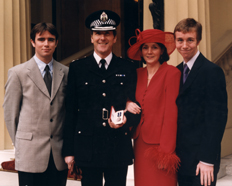
Queens Police Medal
University Security office Stewart Davidson was awarded the Queens Police Medal at the same ceremony. Formerly chief superintendent of Tayside Police he is pictured below, he is pictured below with his family outside Buckingham Palace.
Prize for asthma research
Brian Lipworth, Professor of Allergy and Respiratory Medicine in the Department of Clinical Pharmacology and Therapeutics, has been awarded the prestigious Smithkline Beecham Prize for Research by the British Pharmacological Society. This is a biennial award for outstanding contributions to clinical research. Professor Lipworth has spent 10 years looking at the effects of different treatments for asthma and in particular how this might be influenced by the genetic makeup of patients. It was found that one type of inhaler therapy for asthma seemed to be less effective in genetically predisposed individuals who comprise approximately 40% of the Tayside population. Professor Lipworth and his team in the Asthma and Allergy Research Group are currently evaluating new and established treatments for conditions such as asthma and allergic rhinitis.
Next Page
Return to December/January 2000/1 Contact


